 514-653-4549
 Brossard
Home / Quebec neighborhoods
Brossard
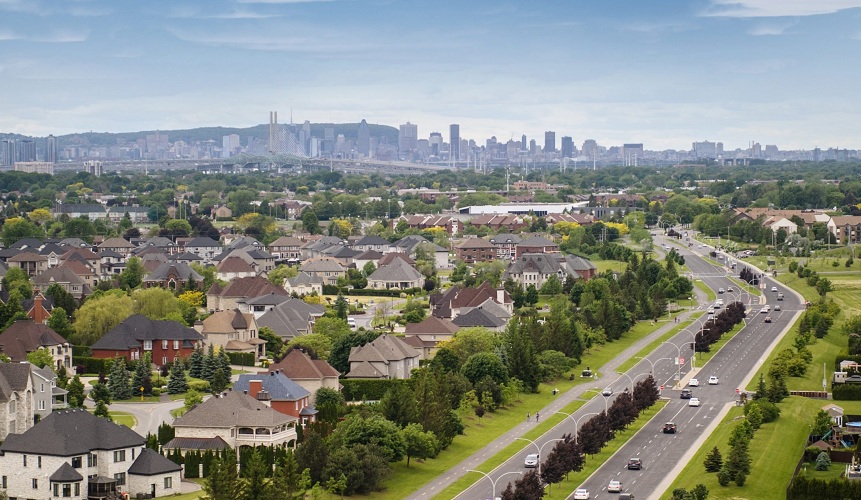
Brossard is a city in Quebec, Canada, located in the southern suburbs of Montreal. According to the last census, the city has a population of approximately 97,697 and is the 12th most populous city in Quebec. It was briefly merged with Longueuil, forming one of its boroughs from 2002 to 2005. It became a municipality again following a referendum, but remains governed by the Longueuil Agglomeration Council.
The city is located along the St. Lawrence and Saint-Jacques Rivers. It is crossed by several major highways (Highways 10, 15, 20, 30, and 132) and roadways (Route 132 and 134). The latter also bears the name Taschereau Boulevard, which crosses the city from east to west, bringing together a large number of shopping centers and businesses, including Mail Champlain. Another large shopping center is Quartier DIX30, located, as its name suggests, at the corner of Highways 10 and 30.
Brossard is home to a large number of cultural communities (during the 2001 census, 45% of the total population belonged to a visible minority), mostly from Asia (China and India), the Maghreb, Haiti, and Jamaica, in addition to being the only officially multicultural city in Quebec. Brossard is also the Quebec city with the highest proportion of Asians in the entire province. Indeed, according to the 2021 census, 20.7% of Brossard residents are Asian. The city also has a Buddhist temple (Lien-Hoa).
The city is geographically located in the Montérégie administrative region in southern Quebec. Its territory lies southwest of Montreal, to which it has been connected by the Samuel de Champlain Bridge (formerly the Champlain Bridge) since 1962, to which it owes its development.
Brossard is known for its division into several sectors, each of whose streets begins with the same letter of the alphabet, except for the main arteries that cross several sectors. For example, within a sector, you'll find Auclair, Anthony, and Auteuil streets. Thus, you'll refer to living in sector "A," "B," or so on. This system of alphabetical sectors dates back to a development and zoning scheme created in the 1960s under a master plan developed by the engineering firm Beauchemin, Beaton, and Lapointe. Its main purpose was to facilitate orientation in the absence of an orthogonal urban grid.
Find the property of your dreams
1 property(ies) in Brossard